What Is PTFE Extrusion and How Does It Work?
Ptfe Extrusion shapes polytetrafluoroethylene into tubes, rods, and profiles used where low friction, chemical resistance, or electrical insulation matters. The process is not ordinary plastic melting. PTFE does not flow like many thermoplastics, so manufacturers use specialized methods and carefully controlled pressure, temperature, and timing. Small changes in powder condition or tooling can affect the finished part.
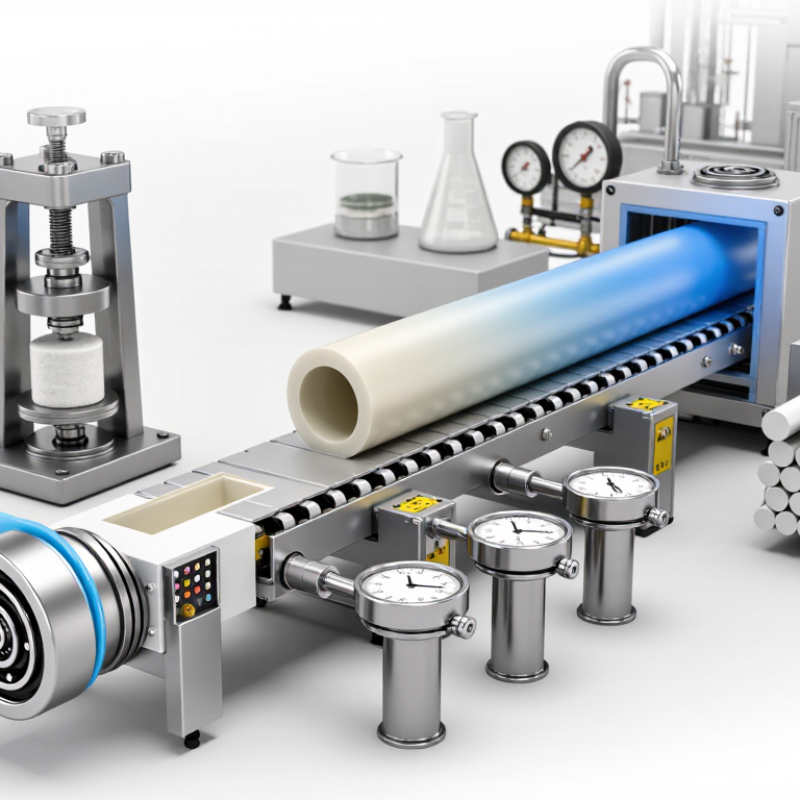
For paste extrusion, fine PTFE powder is blended with a processing lubricant, then compressed into a preform. The material is pushed through a die, which defines its shape; a tube die, for example, forms a hollow passage. The extrudate may look chalky and delicate at this stage. It is then dried to remove lubricant and sintered under controlled heat, allowing the PTFE structure to consolidate. Ram extrusion uses different equipment and feedstock, so not every production line follows the same sequence.
Details matter. Die dimensions, resin grade, extrusion speed, and sintering conditions influence wall thickness, surface quality, and dimensional stability. A narrow tube may need careful inspection for uneven walls or blocked sections. These checks are practical, not decorative. Still, process descriptions can make extrusion sound more predictable than it is; real production involves adjustment, testing, and occasional scrap. This guide explains the main extrusion methods, the equipment involved, and the factors that shape product performance. It also outlines what manufacturers should verify before selecting an extruded PTFE component.
What PTFE Extrusion Is and How Its Properties Affect Processing
PTFE extrusion is not ordinary plastic extrusion. PTFE’s molecular structure gives it exceptional chemical resistance and low friction, but its melt is too viscous to flow like many thermoplastics. Processors therefore commonly use paste extrusion for tubing and profiles. Fine PTFE powder is blended with a processing lubricant, aged, and compressed into a preform. The blend’s condition matters. Small changes can affect how evenly it moves through the die.
A ram then pushes the preform through a shaped opening. Pressure, ram speed, die geometry, and temperature all influence the emerging tube or rod. Too much friction may cause surface marks; uneven flow can create dimensional variation.
The extrudate is heated to remove lubricant, then sintered so the PTFE particles fuse into a continuous structure. Cooling also deserves attention because PTFE expands and contracts noticeably with temperature.
It is tempting to blame every defect on the die. That is often too simple. Powder handling and lubricant distribution may be part of the problem, though diagnosing the cause takes careful measurement. Processing windows can be narrow, and a setting that works for one profile may not suit another.
How Paste and Ram Extrusion Shape PTFE
PTFE extrusion shapes resin into long, consistent profiles without relying on ordinary melt flow. The material does not behave like a typical thermoplastic in a heated extruder. Its structure calls for carefully controlled pressure, temperature, and preparation.
In paste extrusion, fine PTFE powder is blended with a processing lubricant, then gently preformed into a billet. A ram pushes the paste through a die, creating tubing, rod, or another continuous profile. The fresh extrudate can feel soft and vulnerable. It is usually dried to remove lubricant, then heated to sinter the PTFE particles into a stronger structure. Small changes in powder condition or pressure can affect dimensions and surface quality. The process is not perfectly forgiving.
Ram extrusion commonly starts with granular PTFE rather than lubricated fine powder. A hydraulic ram compresses the resin inside a cylinder and drives it through a shaped opening. This method suits longer, relatively uniform parts, though setup and material choice matter. Watch the details. Operators monitor pressure, feed consistency, and the profile as it exits the die. A slight flaw may become a long flaw. Even experienced teams sometimes need to adjust a run, because resin behavior can vary more than a neat process diagram suggests.
How Extruded PTFE Is Heated, Cooled, and Finished
What Is PTFE Extrusion and How Does It Work?
After extrusion, PTFE needs carefully controlled heating, cooling, and finishing. Paste-extruded material first passes through a drying stage to remove processing lubricant. It is then heated until its particles fuse into a continuous structure. NIST reference data place PTFE’s melting transition near 327°C; industrial sintering typically runs above that point. ASTM D4894 and D4895 describe PTFE resin specifications and test methods, but they do not prescribe one universal oven profile. That matters. Wall thickness, extrusion speed, and resin grade all affect heat transfer.
Cooling is not just waiting for the tube to feel cool. A thick section sheds heat more slowly than a thin one, so uneven cooling can leave internal stress or distort dimensions. Controlled air cooling or calibrated cooling zones help maintain roundness and reduce warping. The awkward part is that a fast line may look efficient while hiding uneven shrinkage. It deserves a check. After cooling, manufacturers trim ends, size the tube, and inspect its surface and dimensions. ASTM test methods support consistent evaluation, though a standard cannot replace process-specific trials. I would record temperatures at several points, not just at the oven display.
Where PTFE Extrusion Is Used and How Product Quality Is Checked
PTFE extrusion produces tubing, rods, and profiles for applications where low friction and chemical resistance matter. Depending on the method, PTFE compound is pushed through a die and then sintered to form a stable shape. Extruded tubing may carry chemicals in process equipment or protect wires from heat and electrical exposure. Small seals and liners also use PTFE profiles. The right product depends on temperature, pressure, and contact conditions—not just the material name.
Quality checks begin with dimensions. Technicians measure wall thickness, inside diameter, and ovality at several points along the tube. They inspect the surface for cracks, discoloration, or rough spots. Small defects matter. A cross-section can reveal uneven walls or voids that an outside inspection may miss. Depending on the intended use, testing may also cover tensile strength, electrical properties, or leakage. Results should be compared with the product specification and recorded by production lot. A clean-looking tube is not always a reliable one. And inspection has limits: handling after testing can still damage an otherwise acceptable part.
PTFE Extrusion: Key Thermal Reference Points
PTFE is shaped by paste or ram extrusion and then heated to sinter the material. The chart shows approximate reference ranges, not a production recipe. Product quality is checked using criteria such as dimensions, surface condition, density, and application-specific electrical or mechanical tests.